Could, should, might, don't
This article was inspired by a presentation given by Scott Jenson at Ubuntu Summit. Scott introduced this framework in his talk, and I wanted to expand on it here, exploring how these four modes of thinking apply to UX design, along with the common pitfalls of each.
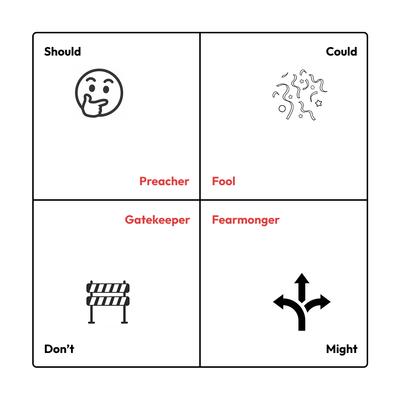
Good forward-thinking UX design draws on four distinct modes of thinking: Could, Should, Might, and Don't. Each serves a different purpose, and teams that move between them make better decisions about where a product is going and how to get there. Each mode also has a counterpart, a less productive version of itself that tends to show up in design and innovation work more than most people notice.
Could: The Visionary
Counterpart: The Fool
"Could" is the Visionary mode: possibility thinking, future orientation, and the kind of brainstorming that asks what a product might become rather than what it is right now. Without it, design tends to stay incremental, responding to immediate needs rather than looking ahead.
The Visionary generates options. It creates space to explore before narrowing, and it keeps teams from locking onto the first viable idea too quickly.
The counterpart is the Fool: lots of vision, not much follow-through. In practice, this looks like concepts that never get tested, features that sound compelling in a meeting but never reach users, and roadmaps that keep growing without anything shipping. The ideas themselves may be good; the problem is the absence of execution.
Should: The Executor
Counterpart: The Preacher
"Should" is the Executor mode: deciding what to actually do, and why. It asks what the business needs, what the metrics indicate, what users have told us matters, and what's necessary to move forward. It's where vision gets translated into decisions and tradeoffs.
The Executor gives a team clarity about what they're working toward. It provides the criteria needed to justify choices, stay aligned with stakeholders, and make tradeoffs without prolonged debate.
The counterpart is the Preacher: someone who is certain about what matters and has stopped asking whether that's still true. In UX, this often looks like an overemphasis on a single metric, whether that's conversion, engagement, or hitting quarterly targets, to the point where other considerations stop getting heard. The product keeps moving, but mostly in one direction.
Might: The Consultant
Counterpart: The Fearmonger
"Might" is the Consultant mode: holding multiple paths open, mapping possibilities, and asking what could happen under different conditions before committing to a direction. The Consultant doesn't push toward a conclusion too quickly. Instead, it surfaces options that wouldn't come up if a team went straight to execution.
In UX, this kind of thinking helps avoid premature closure. It encourages teams to ask what they might be missing, and to consider second-order effects before making decisions.
The counterpart is the Fearmonger: open-ended "what if" thinking that generates concern overshadowing potential possibilities. Without some grounding from "should," the Consultant's open exploration can tip into cataloguing risks until no option feels safe. Once that happens, decisions stall and the team spends more energy managing uncertainty than resolving it.
Don't: The Cornerstone
Counterpart: The Gatekeeper
"Don't" is the Cornerstone mode: the values and commitments that define what a product stands for. It captures the things a team has decided not to do, data practices they won't adopt, tradeoffs they won't make, lines they won't cross. The Cornerstone isn't a list of restrictions so much as a statement of identity, and it gives the other three modes something stable to work from.
The Cornerstone also helps orient decision-making. When a team is unsure where to go, returning to what they've committed not to do can usefully narrow the options.
The counterpart is the Gatekeeper: treating the foundation as fixed in ways that prevent reasonable progress. This shows up as resistance to revisiting old decisions, reluctance to experiment, or reflexive caution about anything that changes existing patterns. The values are sound; the problem is applying them too rigidly.
Using the Frames Well
All four modes are necessary, and a good process draws on each of them at different points. Could keeps teams oriented toward what's possible. Should keeps work grounded in real priorities. Might surfaces options that might otherwise get missed. Don't provides the values and continuity that make long-term direction sustainable.
The counterpart side is what makes the framework especially useful in practice. These less productive versions of each mode are easy to miss because each one resembles the thing it's supposed to be. A team in Preacher mode looks like a team with focus. A team in Fool mode looks like a team with ambition. Being able to name the difference helps teams course-correct without it becoming personal.
The goal isn't to apply this as a rigid process. It's to have a shared language for the kind of thinking a project needs at any given moment, and to notice when one mode has been doing all the work.
Each frame has its place. The goal is to know which one a conversation is in, and whether it's still serving the work.